Intussusception is the invagination of a proximal bowel segment (the intussusceptum) into a distal one (the intussuscipiens). In children it is usually ileocolic and idiopathic, related to lymphoid hyperplasia. In adults a lead point such as a tumour is common.
Clinical presentation
Typically between 6 months and 3 years: episodes of inconsolable crying with drawing up of the legs, vomiting, lethargy and, later, redcurrant jelly stools. The full triad is present in only a minority.
Radiographic features
Ultrasound
- The test of choice, with very high sensitivity
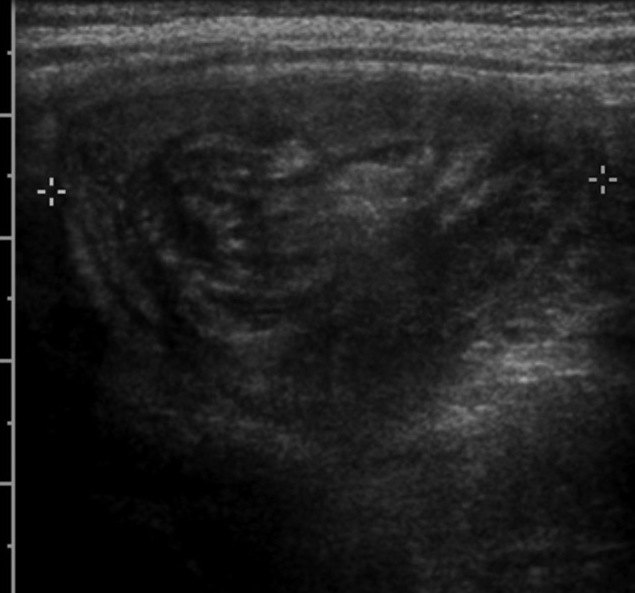
- Target or doughnut sign in cross-section: concentric rings of bowel wall, usually in the right upper quadrant
- Pseudokidney sign in longitudinal section
- Look for trapped fluid and absent Doppler flow, which suggest ischaemia
Abdominal radiograph
May show a soft tissue mass, a crescent sign or obstruction, but a normal film does not exclude the diagnosis.
Treatment and prognosis
Image-guided pneumatic or hydrostatic enema reduction succeeds in most children. Perforation, peritonitis or failed reduction require surgery.
Differential diagnosis
- Gastroenteritis
- Acute appendicitis
- Small bowel obstruction from other causes
Cases and figures
References
- Applegate KE. Intussusception in children: evidence-based diagnosis and treatment. Pediatr Radiol. 2009;39(Suppl 2):S140–S143.
Cite this entry
Intussusception. Radflow Encyclopedia. Last revised 30 October 2026. https://radflow.cc/encyclopedia/intussusception (accessed 15 November 2026).
Related entries
Educational reference for healthcare professionals and students. It is not medical advice and does not replace clinical judgement or local guidelines.